
Why practice
In the food sector, Article 18 of Regulation (EC) No 178/2002 requires businesses to identify their direct suppliers and the business customers they deliver to, one step back and one step forward; other sectors have comparable obligations through contracts or standards. A regular exercise shows whether the ERP lets you respond quickly, and where it gets stuck.
- SupplierReceipt, certificates
- Component lotStarting point
- Manufacturing ordersLot consumption
- Finished-product lotsStock by location
- Deliveries and customersRecall scope
- Upstream trace: from finished product back to supplier.
- Downstream trace: from component to delivered customers.
- Blocking: suspect stock is isolated at every step.
The eight steps
- Pick a component lot and start the clock.
- Find the supplier, the receipt and the related certificates.
- List the manufacturing orders that consumed this lot.
- Identify the finished-product lots affected.
- Locate the remaining stock by location.
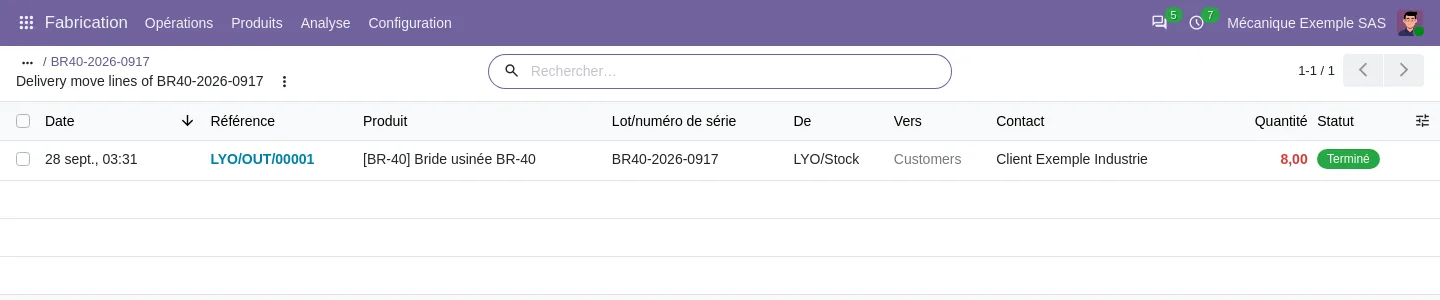
- List the deliveries and customers affected.
- Block the suspect stock and prepare the communication.
- Stop the clock and record the gaps.
What to measure
Total time, the number of manual searches, missing data and unreconciled quantities. A result obtained through a side spreadsheet is a gap, not a success.
Preparing the data
Lot or serial numbers entered at receipt, consumption recorded at the right time, reliable locations and validated deliveries: without these four conditions, no ERP can rebuild the chain.
Limits
The exercise uses fictitious data or a database copy. It replaces neither a validated quality procedure nor the notification obligations specific to your sector.