
The definition
Overall equipment effectiveness combines three losses: availability (stoppages), performance (rate below the reference rate) and quality (non-conforming parts). It is calculated as the product of the three rates.
- Planned timeTime the work center should produce
- AvailabilityMinus stoppages
- PerformanceMinus slowdowns
- QualityMinus non-conforming parts
- Useful timeBasis of OEE
- Odoo Community: productive time / (productive time + losses), over one month.
- Time beyond the expected duration counts as a performance loss.
- Without real-time entry, the rate is only an estimate.
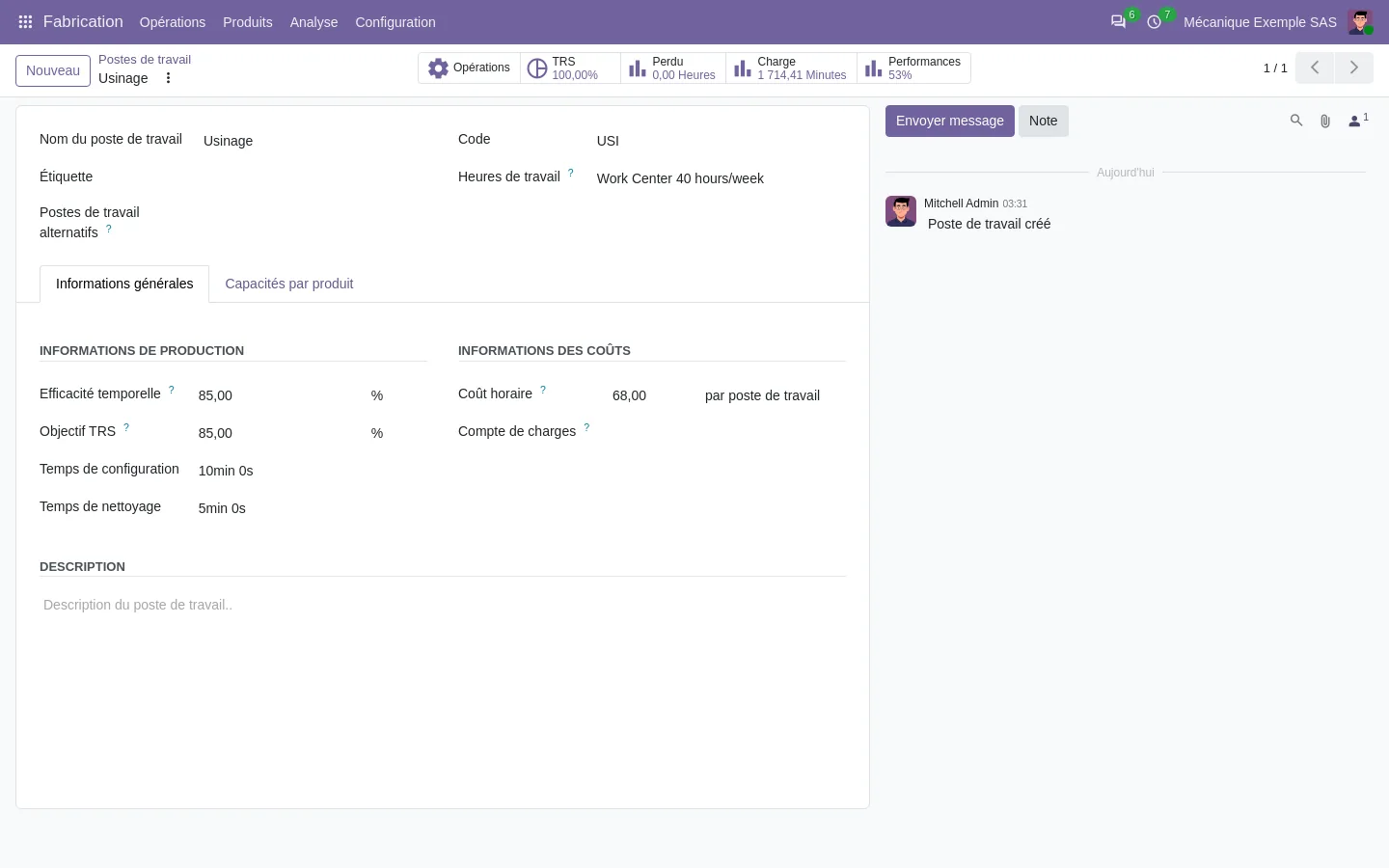
What Odoo Community computes
Each work center shows a rate computed over the last month: productive time divided by productive time plus recorded losses. Losses are classified as availability, performance or quality; the reference rate only comes in through the expected duration of operations: time beyond it is classified as a performance loss.
When to display it
- Stoppages are declared with a reason, when they happen.
- Work order times are entered at the work center, not reconstructed.
- Scrap is recorded on the order concerned, for theoretical OEE.
- A reference rate exists for each product and work center.
When to hold back
If entries are reconstructed at the end of the day, the rate measures data-entry discipline, not the machine. It is better to track stoppages and their causes first, then add the rate once the data is reliable.
Limits
A rate calculated from manual entries remains an estimate. Real-time OEE fed by the machines requires an interface study.